What Determines Double Shaft Shredder Price? 8 Factors Buyers Should Know
Double shaft shredder price is the first question most buyers ask, and the hardest to answer from a catalogue. Two machines can share a chamber size and still sit far apart in cost, because the figure is assembled from motors, blade steel, gearboxes, plate thickness, control level and freight. Here is what a quotation is actually made of.
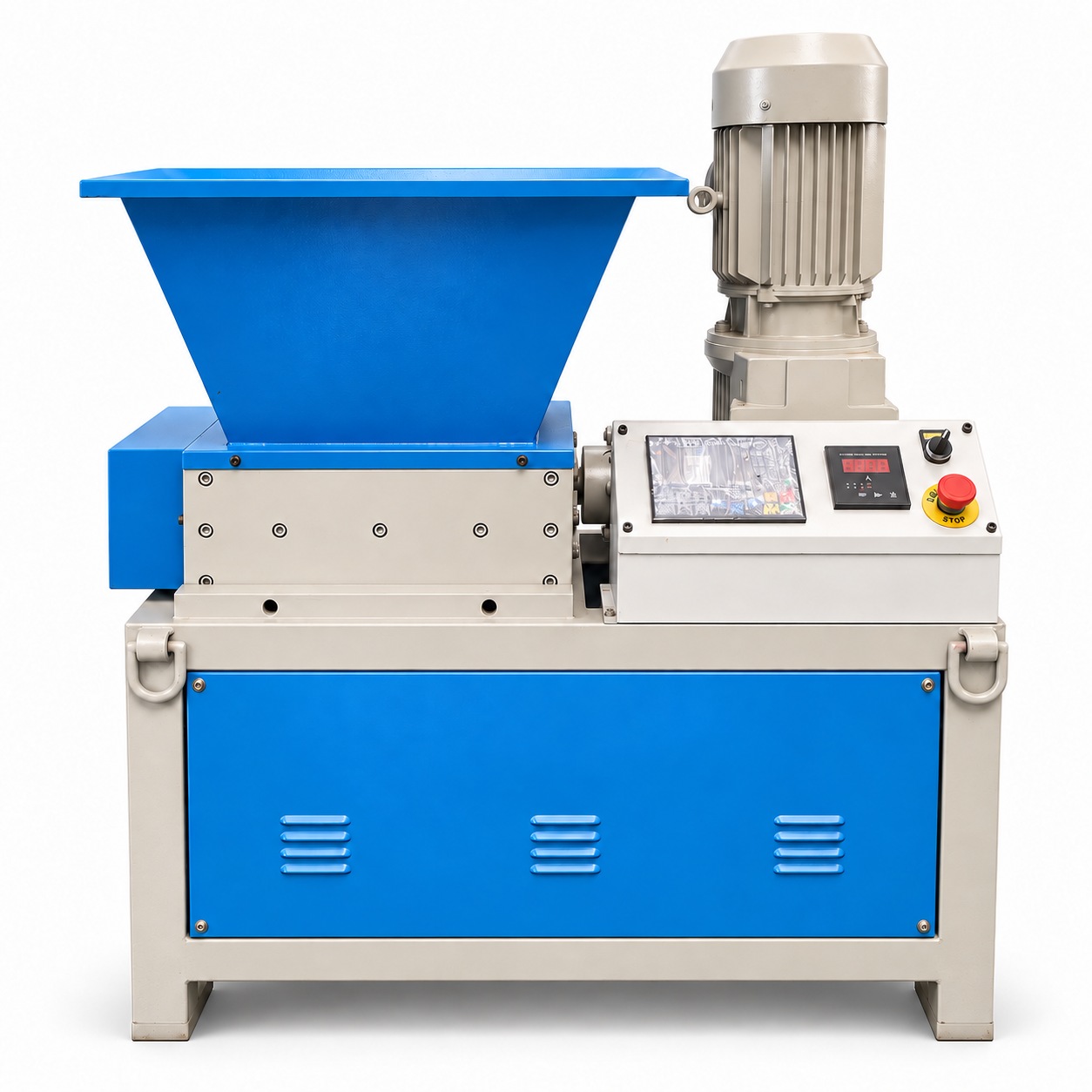
Factor 1: Model Size and Chamber Dimensions
The range runs from the CTSS-330 with a 330 × 330 mm chamber and about 400 kg of installed steel, up to the CTSS-2000 flagship with a 2000 × 1200 mm chamber and roughly 20 tonnes. Rotor diameter, shaft size, bearing seats, frame and machining hours all scale with the chamber, which is why the model — not the word "shredder" — is what a quotation is built on. A laboratory buying a CTSS-330 for light plastic is shopping in a different category from a tyre plant buying a CTSS-1200. The double shaft shredder model table lists chamber, blade diameter, dimensions and weight for all seven sizes.
Factors 2–4: Motor Power, Gearbox and Blade Specification
Motor power starts at a single 3 kW unit on the CTSS-330 and reaches 132 kW × 2 on the CTSS-2000. Because each shaft is driven separately, a second motor brings a second gearbox, coupling, bearing housing and protection circuit. A bigger motor is not just a bigger nameplate: the frame must absorb the extra torque and the reducer must be rated for it.
Gearboxes are the second cost centre. Small models use a KA77 helical unit; mid-range machines use ZQ400, ZQ650 or ZQ1000 reducers; the CTSS-2000 uses ZSY500. Hardened and ground gearing costs more than standard cut gearing, and buyers shredding tyres or light scrap usually specify it, because shock loads destroy a light-duty reducer first.
Blade steel then sets the wear budget. 9CrSi is standard and holds an edge in wood, plastic and cardboard. Cr12MoV and H13 are quoted at a surcharge: Cr12MoV for abrasive streams, H13 for impact and heat, which is why it is often chosen for tyres with bead wire or light metal. Blade count follows chamber width and blade thickness, and thickness is also what changes the output size.
Factor 5: Custom Options — Blade Width, Tooth Profile and Voltage
A standard model is a starting point. Blade width and tooth profile can change — flat, single-claw, double-claw or hook patterns suit different feed material, and a new pattern means new tooling and a one-off run. Voltage is the other variable: 380 V / 50 Hz is standard, while 415 V, 440 V / 60 Hz and 480 V are built to order with a matching starter panel. Anything outside the catalogue carries engineering time, so it is priced individually.
Factors 6–7: Plate Thickness and Automation Level
Material specification sits underneath the price in a way a photo cannot show. Side plates, chamber walls and the base frame are cut from steel plate; thicker plate resists deformation when the machine is fed oversize or wet material, but adds weight and machining hours. A unit built for one shift of cardboard does not need the structure of one fed tyres three shifts a day.
Automation is a separate line item. A basic machine has push-button start and a reversing switch. PLC control with automatic reverse — the controller senses a jam, reverses the shafts and restarts — plus soft start and central lubrication costs more, and is usually the difference between watching the machine and clearing it.
Factor 8: Packing, Freight and Delivery Terms
Packing and freight belong in the landed cost and are often left out of comparisons. Full-container loads travel on a steel frame, braced and protected against rust; less-than-container loads go in plywood cases. Freight then scales with weight and volume, so a 20-tonne CTSS-2000 is a different shipping problem from a 400 kg CTSS-330. Machines ship from Qingdao port, and the freight line depends on destination port, container type and current sailing rates.
Why No Supplier Can Quote From a Keyword Alone
Two buyers can request the same model and receive different prices, because the answer depends on what goes into the hopper. Throughput is a function of bulk density, the largest item that must fit the chamber, the required output size and daily running hours. A 1000 mm chamber shredding hollow drums behaves nothing like the same chamber shredding solid rubber.
So the useful question is not how much does a double shaft shredder cost in general, but what this machine costs for your material at your volume. Send six things: material and largest dimension, daily volume in tonnes, required output size, voltage and frequency, manual or conveyor feeding, and destination port. With those answers a manufacturer can fix the model, blade steel and gearbox grade and quote a real number. Use the inquiry form on the double shaft shredder page or the contact page.
Frequently Asked Questions
Q: Why is there no fixed price list for double shaft shredders?
A: Because almost every unit is configured before it is built. Chamber size, motor power, blade steel, blade count, gearbox grade, voltage, control level and packing all change the specification, and freight depends on destination. A list price would be accurate for one configuration shipped to one place.
Q: How much does a double shaft shredder cost for a small workshop?
A: The smallest standard model, the CTSS-330, is the entry point: 330 × 330 mm chamber, 3 kW motor, about 400 kg. It suits laboratories, sample preparation and light plastic or cardboard work, and its price sits far below the industrial models.
Q: Does a higher blade grade add much to the shredder machine cost?
A: It adds a visible percentage to the quotation, but the fair comparison is cost per tonne processed. Cr12MoV or H13 blades usually last longer between changes in abrasive streams, and each blade change costs labour and downtime as well as parts.
Q: Can the machine be built for my voltage and feeding method?
A: Yes. 380 V / 50 Hz is standard; other voltages and frequencies are built to order with a matching panel. Hopper extensions, conveyors and custom blade profiles are available too.
Need a double shaft shredder price for your material?
Share the material, maximum feed size and daily volume through the double shaft shredder price inquiry form and we reply with a configured quotation within 24 hours. You can also contact our engineers directly or browse all products.