How to Choose a Screw Press Dewatering Machine
Most screw press dewatering machines that disappoint their owners were chosen for the wrong reason. The buyer compared price per unit, or copied the model a neighbouring plant installed, or accepted a capacity figure from a catalogue without checking what material it was measured on. Six months later the machine runs at half the expected throughput, the cake is wetter than promised, and the screen blinds every shift. None of these failures are manufacturing defects. They are selection errors, and they are avoidable.
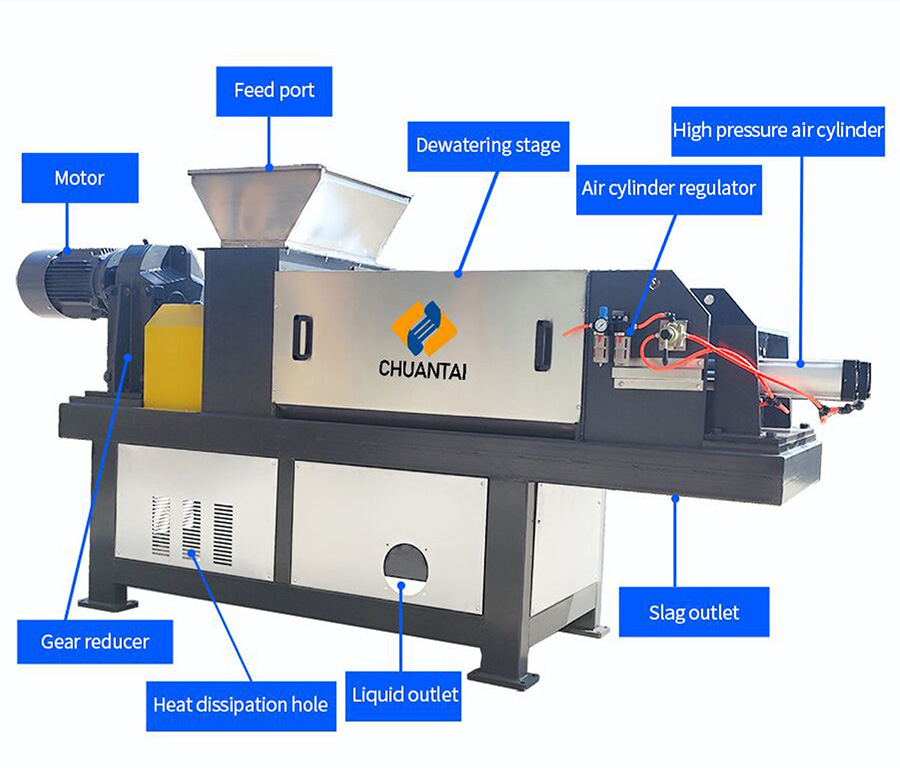
This guide sets out a seven-step method for choosing a screw press dewatering machine that matches your material and your duty. It is written for plant engineers, farm managers and project buyers who need a defensible answer to a simple question: which model, with which screen and which drive, will still be running at spec in five years? If you are still at the stage of comparing suppliers and commercial terms, our screw press machine buyer's guide covers that ground; this article deals with the engineering choice.
Why selection has to start with the material
A screw press does not dewater by pressure alone. It dewaters because the solid particles in the feed build a permeable cake against the screen, and that cake becomes the filter. The screw then compresses the cake and squeezes free liquid out through the screen. If the material cannot form a stable cake — because it has no fibre, because the particles are too fine, or because it is a gel — no amount of extra pressure will produce dry solids. The machine will simply extrude a slurry and wear itself out.
This is why the same model can handle 12 m³/h of citrus peel and only 2 m³/h of a fine, low-fibre residue. Three material properties drive the difference:
- Fibre content and skeleton strength. Long, entangled fibres form a cake that stays open under pressure. Fruit and vegetable residue, manure fibre, paper pulp and hemp all behave well. Fine mineral particles and dissolved organic matter do not.
- Feed dry solids (TS). A feed at 8–12% TS needs far less residence time than a feed at 1–3% TS, because the cake forms sooner and the free water drains faster.
- Particle size, viscosity and stickiness. Fine sticky material blinds the screen, raises torque, and reduces capacity. It also demands a different screen aperture and a longer drainage section.
Get these three right and the rest of the selection follows. Get them wrong and no specification sheet will save the project.
Step 1 — Write the duty down in numbers
Before contacting any supplier, convert your process into three numbers. Every credible quotation is built on them, and a supplier who does not ask for them is guessing.
| Parameter | How to obtain it | Why it decides the model |
|---|---|---|
| Wet feed volume (m³/h) | Measured or calculated from production output and wash water | Directly sets the machine size and the pipe or conveyor size |
| Feed dry solids (%) | Oven-dry test at 105°C, at least three samples across a shift | Determines cake formation speed and realistic cake dryness |
| Operating hours per day | Your shift pattern, including cleaning downtime | Sets the required hourly rate from the daily tonnage |
| Peak factor | Highest week or shift of the year, not the annual average | Prevents the seasonal overload that stops the line |
| Discharge height and layout | Site survey of the reception pit and solids pad | Changes frame height, screw length and cost |
The arithmetic is straightforward. If a factory produces 18 tonnes of wet residue per day at 12% TS and runs two eight-hour shifts, the hourly wet feed is 18 ÷ 16 = 1.125 t/h, which at a bulk density near 1.0 is roughly 1.1 m³/h. The dry solids load is 18 × 0.12 = 2.16 t DS/day. Both figures matter: the volumetric rate sizes the screw, while the dry solids load sizes the drive and predicts the cake output.
Then add margin. A screw press should be selected at 70–80% of its rated capacity on your material, not at 100%. The margin absorbs the peak week, the batch of unusually wet feedstock, and the gradual loss of open screen area as wear and scale accumulate. Selecting at exactly the rated figure is one of the most common causes of chronic underperformance.
A note on the difference between volume and mass
Suppliers quote capacity in m³/h because that is how the inlet and the screw are sized. Buyers often think in tonnes. The conversion depends on bulk density, which for wet organic residue typically falls between 0.85 and 1.1 t/m³, and for dilute suspensions closer to 1.0. Always confirm which unit a quotation uses, and confirm the TS percentage at which the quoted capacity was measured. A capacity quoted at 10% TS is not the same machine duty as one quoted at 2% TS.
Step 2 — Test the material before you commit
A screw press is a mechanical device, so it can be tested. Ask for a trial on your own material, on a machine of the size you intend to buy, with the screen you intend to use. A trial on a different material, or on a laboratory unit with a different geometry, tells you very little.
| Test | Typical method | What it tells you |
|---|---|---|
| Total solids (TS) | Dry at 105°C to constant weight | Feed consistency and the mass balance around the machine |
| Volatile solids (VS) | Ignition at 550°C | Organic fraction; predicts odour, compostability and biogas potential |
| pH | Electrode on a fresh sample | Corrosion risk and whether the material will gel or floc |
| Fibre length and grading | Wet sieving, visual inspection | Whether a cake will form, and which screen aperture suits it |
| Bulk density | Weighed 10 L container | Converts your tonnage into the m³/h a supplier quotes |
| Chloride and sulphide | Laboratory analysis of the liquid phase | Whether SS304 is adequate or SS316L is required |
| Abrasive content | Sand and grit separation test | Screw and screen wear rate, and the need for hard facing |
Run the samples across a full production cycle, not from a single grab. Manure consistency changes with feed ration and bedding; fruit and vegetable waste changes with the harvest calendar; paper pulp changes with the furnish. Three samples taken on different days will expose variation that a single sample hides.
Be cautious with centrifuge data. A laboratory centrifuge can report a cake dryness that a screw press will never reach on the same material, because the centrifuge applies a force that a screw cannot reproduce on a continuous basis. Treat centrifuge results as an upper bound and ask for a screw press trial instead.
Step 3 — Match the screen and the compression to the material
Two mechanical variables do most of the work in a screw press: the screen aperture and the compression profile along the screw. They trade off against each other, and the right combination depends entirely on what you are pressing.
A smaller aperture gives a cleaner liquid and a drier cake, because fewer fine particles pass through. It also reduces open area, raises back pressure and lowers capacity. A larger aperture does the opposite: more throughput, wetter cake, dirtier filtrate. For fibrous agricultural material, 0.75–1.0 mm is common. For fine food processing residue, 0.5 mm is typical. For dilute, fine-particled streams where the objective is volume reduction rather than a saleable solid, 0.3–0.5 mm with a longer drainage section usually performs better.
| Material family | Screen aperture | Compression profile | Realistic cake TS |
|---|---|---|---|
| Dairy and pig manure fibre | 0.75–1.0 mm | Medium, progressive pitch | 28–35% |
| Fruit and vegetable residue | 0.5–0.75 mm | Light to medium, long drainage | 25–40% |
| Tea, coffee and herb residue | 0.5 mm | Medium | 35–45% |
| Paper pulp and recycled fibre | 0.5–0.75 mm | Medium to high | 30–40% |
| Brewery and distillery grains | 0.75–1.0 mm | Medium | 30–38% |
| Biogas digestate | 0.5 mm | Medium, extended drainage | 22–30% |
| Sugarcane bagasse and pith | 0.75 mm | Medium | 30–38% |
Compression is controlled by the screw geometry and by the back pressure device at the discharge — usually a spring-loaded cone or a pneumatic restrictor. More back pressure means a drier cake and higher torque. On a variable material, an adjustable restrictor is worth paying for, because it lets the operator respond to a wet batch without changing the screen.
Step 4 — Size the drive for the worst hour, not the average
Motor power on a screw press is not there to lift the material. It is there to overcome the friction of a cake being compressed against a screen, and that friction rises steeply when the feed gets wetter, finer or more fibrous than expected. A drive sized on average torque will trip on the first cold morning, the first blocked screen, or the first batch of long straw bedding.
Specify a motor with at least 25–30% headroom over the calculated running torque, fit a variable frequency drive so the screw speed can be tuned to the material, and insist on a mechanical or electronic torque limiter that protects the screw and gearbox from a foreign object. The VFD pays for itself twice: it lets you slow the screw for a wet batch instead of blinding the screen, and it reduces starting current on sites with a weak supply.
| Model | Motor power | Capacity (m³/h) | Screw diameter | Typical duty |
|---|---|---|---|---|
| CTYZ-160 | 3 kW | 0.5–1 | 160 mm | Small farm, single restaurant, pilot line |
| CTYZ-200 | 5.5 kW | 2–5 | 200 mm | Small dairy, market waste, small processing plant |
| CTYZ-300 | 15 kW | 5–10 | 300 mm | Mid-size dairy, vegetable packing house, food factory |
| CTYZ-400 | 30 kW | 10–15 | 400 mm | Large dairy, brewery, fruit processing |
| CTYZ-500 | 45 kW | 15–20 | 500 mm | Industrial food waste, paper mill, regional food waste hub |
| CTYZ-600 | 55 kW | 20–30 | 600 mm | Large biogas plant, rendering line or paper mill |
The table is a starting point, not an answer. A CTYZ-300 rated at 5–10 m³/h on vegetable trimmings may only manage 4 m³/h on fine carrot pulp, and a CTYZ-200 rated at 2–5 m³/h can exceed 5 m³/h on dilute dairy wash water. Always cross-check the model against a trial result on your own material.
Step 5 — Choose the construction for the real environment
Standard machines in SS304 suit most food, agricultural and municipal duties. The specification changes when the liquid phase is aggressive:
- High chloride (>500 mg/L) or coastal sites: move wetted parts to SS316L, and specify stainless fasteners and a sealed bearing housing.
- Biogas digestate or sulphide-rich organic residue: SS316L plus an epoxy or rubber lining on the frame, and a wash-down routine that does not leave solids sitting on the screen overnight.
- Abrasive material (sand, grit, shells, soil): hard-faced or replaceable wear strips on the screw flight, and a thicker screen. Sand in dairy manure is the single most common cause of premature screw wear.
- Hot or acidic fruit processing: confirm elastomer and seal compatibility with the actual pH and temperature, not with a generic food-grade claim.
Ask what the wear parts cost and how long they last in your application. A machine that is 15% cheaper to buy but consumes a screen every four months is not cheaper.
Step 6 — Check the plant interface before signing
A screw press is one component in a line, and most commissioning problems are interface problems rather than machine problems.
- Feed method. A progressive cavity or screw pump gives a steady, controllable feed. Gravity feed from a raised pit is simpler but harder to regulate. Avoid feeding with a centrifugal pump on fibrous material; it ropes and blocks.
- Buffer volume. Provide at least 20–30 minutes of storage upstream so the machine can run at a steady rate while the plant delivers in batches.
- Discharge. Confirm the cake outlet height against the trailer, conveyor or pad you intend to use. A machine that discharges at 1.2 m onto a 1.0 m trailer is a daily manual shovel job.
- Wash water. Screen washing needs pressure, not volume: 2–4 bar at the spray bar is more effective than a low-pressure hose. Provide a drain and a wash water connection within reach of the machine.
- Service access. The screw must be able to withdraw in the direction the manufacturer specifies. Leave that space free at layout stage; it cannot be created later.
- Odour and ventilation. Enclosed installations need extract ventilation. Dewatering concentrates odour in the cake, and a closed room without air changes becomes unusable.
Step 7 — Compare total cost of ownership, not purchase price
Purchase price is typically 35–50% of the five-year cost of owning a screw press. The rest is power, wash water, flocculant (where used), wear parts, labour and downtime. Build the comparison on those lines, using your own electricity and labour rates.
| Cost line | How to estimate it | Where machines differ |
|---|---|---|
| Power | Motor kW × hours × load factor × tariff | Drive efficiency and whether the machine runs continuously or on batch |
| Wash water | Litres per hour of operation × water cost | Screen design and cleaning interval |
| Flocculant | kg per tonne dry solids × polymer price | Screw presses generally use less or none on fibrous material; fine-particled streams still dose |
| Wear parts | Screen and screw life in months × replacement cost | Material grade and hard facing |
| Labour | Minutes per shift for inspection and cleaning | Accessibility and how quickly the screen can be cleaned |
| Downtime | Lost throughput × margin per tonne | Spare part availability and whether the design allows quick screen changes |
Two lines are usually decisive. On fibrous material, the flocculant saving of a screw press against a belt press or centrifuge can repay the capital difference within two years. On abrasive material, the wear-part line separates a cheap machine from an appropriate one very quickly.
The five selection mistakes we see most often
- Choosing on average capacity. The machine then fails in the peak week, which is exactly when the plant cannot afford it.
- Quoting cake dryness as a single number. Cake dryness is a range that moves with feed TS, fibre and screw speed. Ask for a range and the conditions it was measured under.
- Ignoring the screen as a wear part. Budget for it from day one and check that the screen can be changed in under an hour.
- Underestimating sand and grit. In dairy and food waste, grit wears the screw flight long before the motor is anywhere near its limit.
- Buying a machine the site cannot service. If the maintenance team cannot reach the screen or withdraw the screw, the machine will be run until it fails.
What to send a supplier for an accurate quotation
A supplier who receives the following can quote a defensible model in a day. A supplier who receives only “a screw press for manure” will quote something, but it will be a guess.
- Material type and source process, with a photograph of the material
- Feed TS, VS, pH and bulk density, with the test method used
- Daily tonnage and the hours per day the machine will run
- Peak week tonnage, and how much variation you see across the year
- Target cake dryness, or the disposal route that sets the requirement
- Available power supply, voltage and phase
- Site layout: feed point, discharge point, drain and wash water
- Any constraint on floor space, ceiling height or noise
Frequently asked questions
How do I calculate the screw press capacity I need?
Divide the daily wet tonnage by the hours the machine will actually run, then add 25–30% margin. Check the result against the dry solids load as well, because a machine can be volume-limited on dilute feed or torque-limited on concentrated feed. The lower of the two limits is your real capacity.
Can one screw press handle several different materials?
Yes, with limits. Materials with similar fibre structure and similar feed TS can share a machine, and a variable frequency drive plus an adjustable discharge restrictor widens the window considerably. Mixing a fibrous agricultural residue with a fine mineral residue on the same machine usually means compromising both duties.
What cake dryness can I realistically expect?
On fibrous organic material, 28–40% TS is typical. On fine, low-fibre organic residue, 20–28% TS is realistic, and higher figures usually require flocculant, a longer pressing section or a different technology. Treat any claim above these ranges as conditional on a trial.
Do I need to add polymer?
On manure, fruit and vegetable residue, brewery grains and paper pulp, usually not. On fine, low-fibre material with a high colloidal fraction, a low dose of polymer may be needed to build floc that the screen can retain. If a supplier proposes polymer for a fibrous material, ask why.
How much maintenance does a screw press need?
Routine work is short: a visual check and a screen rinse each shift, a weekly inspection of the screen and the discharge restrictor, and periodic greasing of bearings. The significant items are scheduled: screen replacement and screw wear inspection, with intervals that depend on abrasiveness.
How long does a trial take?
A properly run trial on your material typically needs 50–200 kg of representative sample and a few hours on a machine of the intended size. Ask for the trial report to record feed TS, throughput, cake TS, filtrate quality and motor current, because those five numbers are what you will hold the supplier to.
Final thoughts
Choosing a screw press dewatering machine is a sequence, not a comparison. Measure the duty, test the material, match the screen and compression, size the drive with headroom, specify construction for the real liquid, confirm the interfaces and cost the whole life. Do that and the model number becomes almost obvious.
The reverse is also true. When a screw press underperforms, the cause is usually traceable to a step that was skipped, and the fix is usually a screen, a restrictor setting or a feed condition rather than a new machine. If you already have test data, send it to us and we will tell you which CTYZ model fits and what cake dryness to expect on your material.
Send us your material test data and we will size a screw press for your duty.
Contact our engineers on WhatsApp for model selection and a free quote.
Related: Screw press dewatering machine · Screw press machine buyer's guide · Application guide · Request a selection sheet