Screw Press Manure Separator for Dairy Farms
A dairy farm that separates its slurry before storage solves four problems with one machine. It recovers bedding from material it was already paying to dispose of, it shrinks the volume that has to be stored and hauled, it protects the lagoon from a solids load that settles and seals, and it turns a wet waste into two streams that can each be used properly. None of this requires a large herd, and none of it depends on a complicated process.
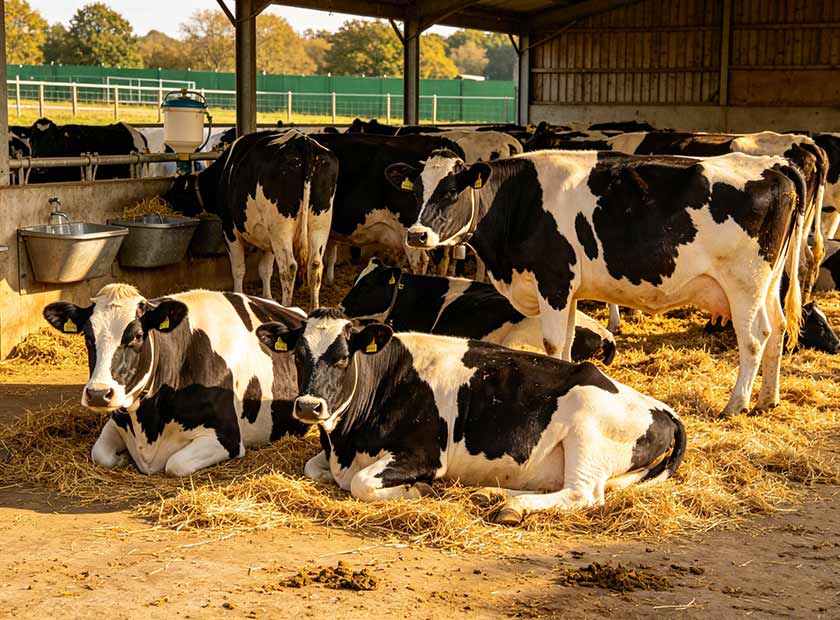
The difficulty is sizing. Separators are commonly sold on a capacity figure measured on a different material, in a different housing system, at a different dilution. A machine that is right for 300 housed cows on sand bedding is not the right machine for 800 cows on a flush system. This guide works through the numbers that decide the model, the bedding quality you can realistically recover, and the payback you can defend to a bank.
What a manure separator actually does
A screw press separator receives raw slurry, screens out the coarse fraction and compresses it against a cylindrical screen with a rotating auger. Liquid drains through the screen; the solids are pushed along a narrowing channel and out through a discharge restrictor as a stackable fibrous material.
The change in physical form is the point. Raw dairy slurry at 8–14% dry solids behaves as a liquid: it has to be pumped, it cannot be stacked, and it generates odour and flies. After separation the solid fraction typically reaches 28–35% dry solids, which is stackable, compostable, usable as bedding or saleable as a soil amendment. The liquid fraction retains the fine particles, the dissolved nutrients and most of the water.
| Stream | Typical dry solids | Share of input mass | Where it goes |
|---|---|---|---|
| Raw slurry into the separator | 8–14% | 100% | From scraped or flushed alleys |
| Solid fraction out | 28–35% | 20–30% | Bedding, compost, soil amendment, biogas |
| Liquid fraction out | 2–5% | 70–80% | Irrigation, lagoon, digester, flush recycling |
Two numbers in that table deserve attention. First, the separator does not remove water from the farm; it moves water from the solid stream to the liquid stream. Second, the solid fraction still contains 65–72% water. That is normal for mechanical separation, and it is why separated solids are composted or used as bedding rather than sold as a dry product.
The four reasons dairy farms install a separator
1. Bedding recovery
This is usually the strongest economic driver. Separated manure solids can be used as free-stall bedding, either directly or after composting. The saving is the cost of the sawdust, straw, sand or mattresses the farm would otherwise buy, plus the handling that goes with them. A farm buying 4 kg of sawdust per cow per day for 500 cows is buying two tonnes a day; replacing even 60% of that with separated solids changes the operating budget materially.
The constraint is hygiene and comfort. Fresh separated solids have a high moisture content and a high bacterial load, and used directly they can raise udder health risk, particularly in warm weather. Many farms compost the solids for 3–6 weeks before use, which stabilises them and reduces pathogen pressure. If the material will be used as bedding, plan the composting pad and the turning equipment at the same time as the separator, not afterwards.
2. Storage volume and haulage cost
A 500-cow dairy on a scraped system produces 30–40 m³ of slurry a day. Over a six-month storage period that is 5,400–7,200 m³, which is a large lagoon and a large haulage bill. Separating first does not reduce the volume proportionally, but it does make 20–30% of the mass stackable on a pad rather than stored as liquid, and it makes the remaining liquid easier to pump, irrigate and stir.
The practical effect is often a smaller lagoon requirement, fewer tanker loads, and less crust formation. On farms where the lagoon is already at capacity, separation can defer or avoid a capital project entirely.
3. Biogas and digester performance
If the farm supplies a biogas plant, separation changes the feedstock in two ways. The solid fraction has a higher energy density per tonne and can be fed to a dry or high-solids digester; the liquid fraction is easier to pump and has a lower solids load, which reduces mixing energy and sediment in the tank. Many digesters prefer the liquid fraction as the base feedstock and take the solids separately.
Decide with the digester operator before choosing the screen. A finer screen sends more fibre to the liquid stream, which increases biogas yield from the liquid but raises the risk of sediment and floating crust in the tank.
4. Nutrient management and ammonia control
The liquid fraction carries most of the nitrogen and potassium, and the solid fraction carries most of the phosphorus and organic carbon. Separation therefore lets a farm allocate nutrients to fields according to crop demand rather than applying a mixed slurry everywhere. On nitrate-vulnerable land, that flexibility is worth more than the machine.
Inside the barn, removing the solids reduces the organic material available for anaerobic decomposition, which reduces ammonia and hydrogen sulphide release from the alleys and the store. Farms often report easier fly control as a secondary benefit, because the breeding material in wet solids is removed.
Sizing: how much slurry does your herd produce?
Capacity calculations fail when they use a textbook figure for “a cow”. The volume depends on body weight, feed and water intake, bedding type, and above all on how the alleys are cleaned. Use the figures below as a starting range and adjust them to your own records if you have them.
| Herd size | Scraped alleys (m³/day) | Flushed alleys (m³/day) | Recommended model | Run time at rated capacity |
|---|---|---|---|---|
| 100 cows | 6–8 | 15–20 | CTYZ-200 | 2–4 h |
| 200 cows | 12–16 | 30–40 | CTYZ-300 | 3–5 h |
| 350 cows | 21–28 | 50–70 | CTYZ-400 | 3–5 h |
| 500 cows | 30–40 | 75–100 | CTYZ-400 or CTYZ-500 | 4–6 h |
| 800 cows | 48–64 | 120–160 | CTYZ-500 | 4–7 h |
| 1,200 cows | 72–96 | 180–240 | CTYZ-600 or two units | 5–8 h |
Three corrections are worth making before you commit to a model. First, if the herd is expanding within the life of the machine, size for the future herd, not today's. Second, if calving is seasonal, the peak month may be 20–30% above the annual average. Third, if the separator will also take parlour wash water or run-off, add that volume — it is often 10–20% of the total and it is easy to forget.
Running time matters as much as capacity. A separator is usually run once or twice a day rather than continuously, so a machine rated at 10 m³/h handling 35 m³/day runs about four hours. That is comfortable. If the same farm chose a 5 m³/h machine to save money, it would need seven hours and would have no margin for a blocked screen or a late start.
Comparing separator types for dairy slurry
| Type | Cake TS | Power per m³ | Polymer | Notes |
|---|---|---|---|---|
| Screw press separator | 28–35% | Low | Not normally | Continuous, tolerant of fibre, simple maintenance, good bedding material |
| Roller press | 30–38% | Low | Not normally | Good on fibrous slurry, more sensitive to stones and grit |
| Belt press | 25–32% | Medium | Sometimes | Needs wash water and more attention; higher throughput per metre |
| Decanter centrifuge | 28–35% | High | Usually | Compact and enclosed, but high power and maintenance cost for farm duties |
| Sloped static screen | 15–22% | None | No | Cheap pre-thickening only; not a substitute for a press |
For a dairy farm the screw press is usually the appropriate choice: it tolerates the fibre and the stones that come with scraped alleys, it does not need polymer, it runs on a modest motor, and its maintenance is within the capability of a farm workshop. A belt press can be justified where volumes are very large and labour is available for washing; a decanter is rarely justified on a farm unless the solids have a specific market.
What bedding quality can you expect?
Separated dairy solids used as bedding typically sit at 30–35% dry solids, which is comfortable under cattle but still moist enough to support bacterial growth. Three practices make the difference between bedding that works and bedding that causes problems:
- Use a finer screen for bedding. A 0.5–0.75 mm screen produces a softer, more absorbent solid than a 1.0 mm screen, at some cost in throughput.
- Compost before use. Three to six weeks of turned composting raises dry matter, reduces odour and lowers the bacterial load. It also kills weed seeds if the pile reaches temperature.
- Deep-bed or top-up daily. Thin layers of fresh solids stay wet. A deeper bed that is topped up daily and cleaned out on a stall-by-stall cycle performs better.
If the herd is on sand bedding, separation becomes harder. Sand abrades the screw and screen, and the separated solids contain sand that reduces their value as bedding. In that case, a sand separation lane ahead of the screw press is the usual solution, and the screw press should be specified with hard-faced wear protection.
Layout: scraped versus flushed alleys
The housing system determines the layout more than the machine does.
On a scraped system, slurry arrives at the reception pit in batches through an alley scraper or a robot. Provide a pit of at least 10–15 m³ so the separator can run steadily while the scraper cycles. Agitate the pit before pumping, and fit a coarse grid over the pit to catch stones, gloves and silage wrap — the most common cause of a jammed screw is something that should never have reached it.
On a flushed system, the volume is much larger and much more dilute. Separating diluted slurry gives a wetter cake and requires a larger machine for the same number of cows. Many flushed farms separate the flush water and recycle the liquid fraction for flushing again, which reduces fresh water demand and keeps the solids out of the lagoon. That recycle loop needs a storage tank sized for at least one day and a pump matched to the flush cycle.
In both cases, place the separator on a concrete pad with a slope to a collection channel, and leave enough room on the solids side for a trailer or a loader to work. A machine that discharges into a space a tractor cannot reach will be run less often than it should.
Running and maintaining a farm separator
The daily routine is short and it is what determines whether the machine lasts ten years or three:
- Each shift: check that the screen is clear, listen for changes in pitch, and confirm the cake is coming out as a firm, stackable ribbon rather than a wet paste.
- Daily: wash the screen from the outside with the machine running, and check the discharge restrictor for wear.
- Weekly: inspect the screen for holes and blinded areas, grease the bearings, and check the drive belt or coupling.
- Seasonally: inspect the screw flight for wear, particularly the last third where compression is highest, and check the gearbox oil.
In winter, the main risks are freezing and gelling. Drain the wash water line, keep the machine running daily rather than letting slurry sit in the inlet, and do not let solids accumulate on the pad where they will freeze into a block. A separator that is stopped for a week in freezing weather is much harder to restart than one that runs for an hour a day.
Payback: a worked example for 500 cows
The following example is illustrative and uses round figures so that a farm can substitute its own prices. It assumes 500 housed cows, scraped alleys, 35 m³ of slurry per day, a CTYZ-400 running five hours a day, and separated solids used as bedding after composting.
| Line | Basis | Annual effect |
|---|---|---|
| Bedding purchase avoided | 500 cows × 4 kg/day × 60% replaced × 365 days = 438 t | Cost avoided |
| Solid fraction haulage avoided | About 2,900 t/year of solid fraction no longer tankered as slurry | Cost avoided |
| Lagoon storage requirement | 20–30% of mass moved to a stackable pad | Capital deferred |
| Separator power | 30 kW × 5 h × 350 days at local tariff | Cost incurred |
| Wear parts and maintenance | Screen and screw allowance, plus greasing and labour | Cost incurred |
| Composting pad and turning | One-off capital plus annual fuel or contractor cost | Cost incurred |
On most farms the bedding saving alone covers the operating cost, and the haulage and storage savings carry the capital payback. Where bedding is cheap and slurry is spread on nearby land at low cost, payback is slower and the case rests on lagoon pressure, odour complaints or nutrient planning. Be honest about which of those applies to your farm before you build the business case.
Frequently asked questions
How many cows can one screw press separator handle?
A CTYZ-200 suits around 100–200 cows on scraped alleys, a CTYZ-300 around 200–350, and a CTYZ-400 or CTYZ-500 around 350–800 depending on run time and dilution. Flushed systems need a larger machine for the same herd because the volume is two to three times higher.
Can I use separated solids as free-stall bedding straight away?
It is possible but not ideal. Fresh solids are moist and carry a high bacterial load. Composting for three to six weeks produces a drier, more stable material with lower pathogen pressure, and most farms that bed on separated solids adopt composting as standard practice.
Will a separator reduce the volume of slurry I have to store?
It moves 20–30% of the mass into a stackable solid fraction, which reduces the liquid volume that needs tank storage and makes the remainder easier to pump and irrigate. It does not eliminate water, so the reduction is in storage and haulage of solids rather than in total water volume.
What happens if stones or sand get into the separator?
They accelerate wear on the screw flight and the screen, and a large stone can jam or break the screw. Fit a coarse grid at the reception pit, keep the scraper channel clean, and specify hard-faced wear protection if the herd is on sand bedding.
Does a separator work with flushed alleys?
Yes, and it is often used to recover flush water for reuse. The slurry is more dilute, so the cake is wetter and the machine must be larger for the same herd. A one-day buffer tank and a matched pump are usually needed to make the recycle loop work.
How much maintenance does it need?
A rinse and a visual check each shift, a weekly screen inspection and greasing, and a seasonal inspection of the screw and gearbox. The main consumable is the screen, and its life depends on abrasiveness and how consistently the machine is washed.
Final thoughts
A screw press manure separator is one of the few pieces of dairy equipment that produces a usable input while solving a disposal problem. The machine itself is simple; the selection is where projects succeed or fail. Size from your own slurry volume, correct for housing system and peak month, decide the bedding route before you order, and plan the pad and the composting space at the same time.
If you send us your herd size, housing system, bedding type and current slurry volume, we will return a model recommendation, an expected mass balance and an indicative payback structure for your farm.
Tell us your herd size and housing system and we will size a separator for your farm.
Contact our engineers on WhatsApp for model selection and a free quote.
Related: Screw press separator · Cow dung dewatering machine · Separators in agriculture · Request a sizing calculation