Spent Grain Dewatering with a Screw Press: A Brewery and Distillery Guide
Every litre of beer leaves behind roughly 0.2 kg of wet spent grain, and every batch of whisky or ethanol leaves even more. At 75–85% moisture, this stream is heavy, ferments within days, and gets more expensive to haul every year. A spent grain screw press solves the problem mechanically: it squeezes free water out of the grain continuously, cutting weight by 40–60% before the grain ever reaches a truck, a dryer, or a digester.
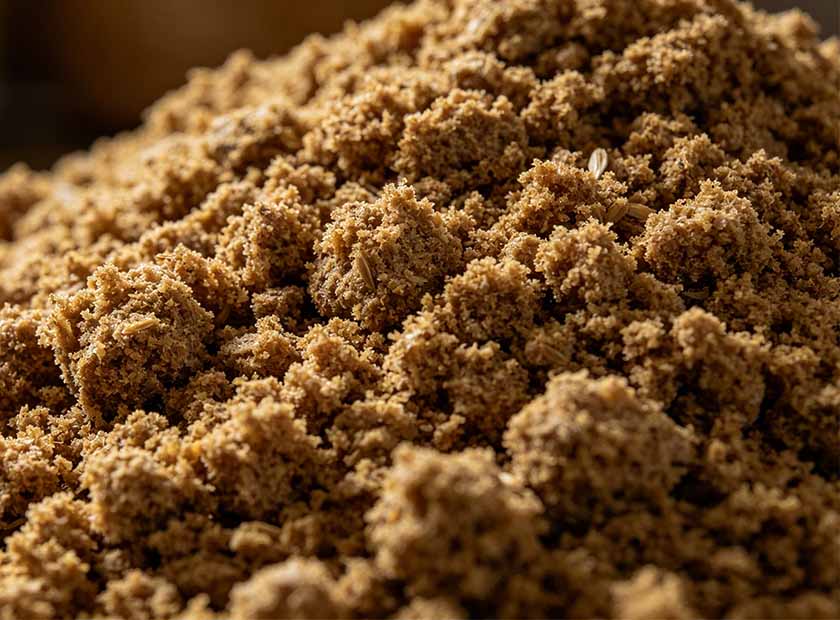
Why Wet Spent Grain Costs Breweries Money
Fresh brewer’s spent grain (BSG) comes off the lauter tun at 75–85% moisture. At that water content, you are paying to transport mostly water: a 20-tonne load of wet grain may carry only 3–4 tonnes of actual dry solids. The material also spoils quickly — within two to four days at ambient temperature — which forces daily or even twice-daily pickups and limits how far you can economically ship it.
Disposal rules add pressure. Many regions now restrict landfilling of high-moisture organic waste or charge rising gate fees for it. Farms that once took wet grain for free increasingly expect it delivered drier, or charge for handling it.
What Dewatering Actually Achieves
Mechanical dewatering with a screw press removes free water only — it does not cook the grain or change it chemically. Even so, the operational gains are substantial:
- Moisture drops from 80–85% to roughly 55–60%, and weight falls by 40–60% in a single pass.
- Storage life extends from days to weeks, so pickups can be consolidated.
- Transport cost per tonne of dry solids falls sharply — fewer truckloads for the same grain.
- If the grain goes to a dryer, mechanical pressing first removes most of the water at a fraction of the energy a dryer would use.
- Drier grain opens better markets: wet feed at 60% moisture moves further and commands a firmer price than slop at 80%.
How a Spent Grain Screw Press Works
Wet grain is dropped or conveyed into an inlet hopper, where a rotating screw with progressively narrowing pitch (a variable-pitch screw) carries it through a cylindrical wedge-wire screen basket. As the pitch tightens, pressure builds and free water drains through the screen slots into a collection trough below. The compressed grain plug exits at the discharge end, where an adjustable back-pressure cone sets the final dryness — tighten it for drier cake, open it for higher throughput.
The process is fully continuous, so the press tracks the brewhouse rather than working in batches. Screw speed stays low (typically 15–30 rpm on our CTYZ range), which keeps power draw modest — the CTYZ-300, for example, is rated at 15 kW for 5–10 m³/h of wet feed.
Brewery grain versus distillery grain
Brewer’s spent grain carries a lot of fine particles alongside the husk, so screen selection matters: a 0.5–1.0 mm wedge-wire aperture balances drainage against solids carry-over. Distillery mash — hotter, stickier, and often corn-based — benefits from the same continuous pressing but may need a slightly larger screen aperture and a steadier feed to avoid sticky pockets. It is also worth separating wet distillers grains from DDGS in your planning: DDGS is already dried, while wet distillers grains are exactly the kind of stream a screw press handles before any drying step.
Choosing the Right Model
Size the press to your wet-grain output per hour, not to weekly production. As a rough guide, a pub-scale or craft brewery with modest grain output fits the CTYZ-200; regional breweries typically land on the CTYZ-300 or CTYZ-400; large industrial breweries and distilleries move to the CTYZ-500 or CTYZ-600.
| Model | Motor Power | Processing Capacity | Screw Diameter |
|---|---|---|---|
| CTYZ-160 | 3 kW | 0.5–1 m³/h | 160 mm |
| CTYZ-200 | 5.5 kW | 2–5 m³/h | 200 mm |
| CTYZ-300 | 15 kW | 5–10 m³/h | 300 mm |
| CTYZ-400 | 30 kW | 10–15 m³/h | 400 mm |
| CTYZ-500 | 45 kW | 15–20 m³/h | 500 mm |
| CTYZ-600 | 55 kW | 20–30 m³/h | 600 mm |
Operating Tips That Extend Screen Life
- Keep the feed rate steady; surges overload the compression zone and push fines through the screen.
- Flush the screen basket with warm water between brews to prevent fine particle blinding.
- Specify 304 stainless steel (or 316L where cleaning chemicals are aggressive) for all wetted parts.
- Adjust the back-pressure cone in small steps and record the moisture result each time.
- Keep a spare screen basket on site; swapping one takes minutes, not shifts.
What Dewatered Spent Grain Is Worth
At 55–60% moisture, spent grain becomes a product rather than a waste problem. Dairy and beef farms use it as a wet feed with meaningful protein and fibre content. Mushroom growers take it as substrate. Biogas plants feed it to anaerobic digesters, where the pressed grain and the pressed liquor both have value. Some breweries dry the pressed cake further for pelletising — and because the press already removed most of the water, the dryer can be sized much smaller.
The economics usually close quickly: between lower hauling fees, fewer collections, and grain that sells instead of costing gate fees, a press in the 5–10 m³/h class commonly pays back within one to two seasons of operation. Send us your wet-grain output and current disposal cost, and we will size the model and estimate the return for your site.
What moisture can a screw press reach on spent grain?
A single pass typically brings brewer’s spent grain from 80–85% down to about 55–60% moisture. Lower values need thermal drying, which the press makes far cheaper by removing most of the water mechanically first.
Does dewatering replace drying?
No. A screw press removes free water only. But it cuts the dryer’s load dramatically, so for pelletising or DDGS-style products the standard approach is press first, dry second.
Which model fits a mid-size brewery?
A regional brewery producing several hundred hectolitres per batch usually fits the CTYZ-300 (5–10 m³/h) or CTYZ-400 (10–15 m³/h). Match the model to peak wet-grain output per hour, not to weekly volume.
Will fine particles clog the screen?
Fine particles can blind the screen over a long run. A 0.5–1.0 mm wedge-wire aperture, steady feeding, and a warm-water flush between brews keep drainage open.
How much does a spent grain screw press cost?
Price depends on model size, screen specification, and options such as feed conveyors. Contact our engineers with your wet-grain volume for a model recommendation and a firm quotation.
Need a spent grain screw press sized to your brewhouse?
Contact our engineers on WhatsApp for model selection and a free quote.
Related: Brewers grains application · Distillers grains application · Coffee grounds dewatering guide · CTYZ-400 screw press