Double Shaft Shredder for Tire Recycling: From Whole Tires to Clean Rubber Chips
Whole waste tires are the most awkward item in a recycling yard: they do not crush, do not compact, and spring back the moment pressure is released. A double shaft shredder for tire recycling tears the tire apart between two slow-turning, high-torque shafts instead of slicing it in one pass. This guide covers why that works, how feeding and output size are controlled, what the chips are worth, and which CTSS model to specify.
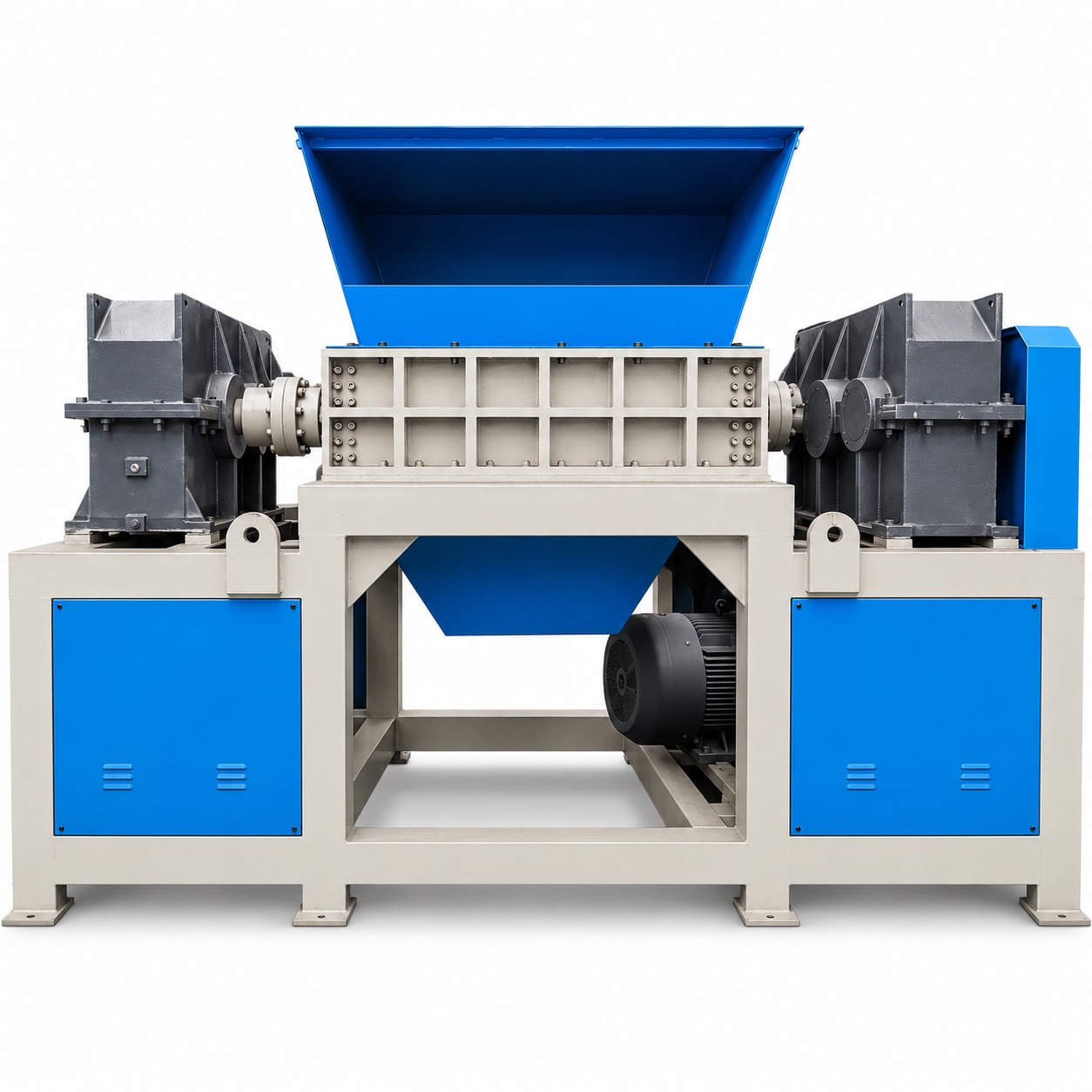
Why Tires Need a Twin-Shaft Shredder, Not a Granulator
A passenger tire is a composite, not a block of rubber: steel bead bundles, steel cord in the belt plies, fabric and a highly elastic compound. A high-speed single-shaft granulator relies on cutters striking at speed; rubber deflects that impact, and bead wire chips the knife edges within a short run.
A tire shredder machine of the twin-shaft type works differently. Two hexagonal shafts carry intermeshing multi-claw blades turning at 10–20 rpm. Material is dragged into the gap and torn between the hooks rather than cut cleanly; slow torque lets the edge bite instead of bounce, and low speed keeps dust, noise and heat down.
Wrapping is the other reason. Tires wind around anything that rotates: on a single-shaft rotor a carcass ropes the shaft and stalls the drive. On twin shafts the opposite claws clean the gap continuously, so the tire is pulled down and torn apart. Low speed with high torque is the right specification for rubber.
Whole Tires or Pre-Cut? Feed Opening, Bead and Throughput
A 195/65 R15 passenger tire measures about 630 mm across; an 11R22.5 truck tire roughly 1050 mm. The CTSS-1000 has a 1000×600 mm feed opening and the CTSS-1200 a 1200×800 mm opening, so car and light-truck tires drop in whole. Wider truck and OTR casings need one sidewall cut or a split into halves.
Pre-cutting is a trade-off, not a rule. It doubles handling and needs an extra machine and operator, but raises throughput and cushions the shock loads reaching the blades. Above roughly 30% truck or OTR casing in the feed, pre-cut; below that, feed whole.
The steel bead is the densest part of the tire and the main driver of blade wear. Specify hardened 9CrSi blades, with Cr12MoV or H13 as the premium option, and keep a spare set on the shelf. Feed steadily rather than dumping a full hopper — continuous loading avoids the torque spikes that damage gearboxes.
From 50–150 mm Strips to Saleable Rubber
A twin-shaft machine is a primary shredder, so its output is deliberately coarse: a 400 mm blade diameter and 40–75 mm discs on the CTSS-1200 produce torn strips and irregular chips of 50–150 mm. Strip width follows blade thickness, customized per project.
Coarse output is often what the buyer wants. TDF for a cement kiln is usually specified at 50–150 mm so it burns on the grate without falling through, and a chip that size conveys and stockpiles without bridging. For rubber powder — sports infill, mats, modified asphalt — the strips pass a granulator to 10–20 mm, then a cracker mill to 0.5–4 mm, with magnet and textile separation between stages.
Three routes carry the material to market. TDF is the largest by volume, and its price tracks calorific value, moisture, wire content and the kiln's size specification. Granulate and powder earn more per tonne but need cleaner feed, so textile contamination is controlled at the shredding stage. Recovered steel is roughly 10–15% of a passenger tire by weight; a magnetic pulley on the discharge conveyor pays for itself quickly.
Choosing Between CTSS-1000 and CTSS-1200 for Tires
Both models sit in the tire-capable part of the double shaft shredder range. The CTSS-1000 runs a 1000×600 mm opening, 300 mm blades, 30 kW × 2 and weighs about 4,000 kg. The CTSS-1200 steps up to a 1200×800 mm opening, 400 mm blades, 37 kW × 2 (74 kW installed) and 5,500 kg on a 4000×1500×2200 mm footprint.
Choose the CTSS-1000 for a tire shop, transfer station or small yard on one shift with passenger and light-truck casings, up to roughly 2–3 t/h. Its 300 mm blades give finer strips, and the smaller frame fits tight sites.
Choose the CTSS-1200 when whole truck tires must drop in without pre-cutting, when the plant runs two shifts, or when a granulator needs a steadier feed. The 74 kW installed power and 400 mm blades work through bead bundles with fewer stalls. Above that, the CTSS-1500 (90 kW × 2) and CTSS-2000 (132 kW × 2) serve multi-tonne lines.
Site planning matters as much as the model number. Standard voltage is 380 V / 50 Hz, customizable; 74 kW installed draws roughly 150 A per phase, so confirm transformer and cable sizing early. Leave 1.5 m clear for the discharge conveyor and pour a level plinth. For wet organic waste, see the applications overview.
TDF Shredders: Preparing Rubber for Tire-Derived Fuel
Tire-derived fuel (TDF) is one of the largest outlets for end-of-life tires, used by cement kilns, paper mills and power plants. Most TDF buyers specify chip sizes between 50 mm and 300 mm with strict limits on free wire. A double shaft shredder set up as a TDF shredder produces exactly this middle-grade chip: large enough for kiln injection systems, clean enough after one or two passes over an over-band magnet.
The same CTSS line that produces crumb rubber feedstock can therefore serve TDF contracts. If cement kilns operate in your market, request their chip specification first. Producing to a fixed specification, rather than shredding as fine as possible, protects your margin on both electricity and blade wear.
Frequently Asked Questions
Can a double shaft shredder handle tires with the steel bead still in?
Yes. Twin-shaft machines take whole tires including the bead; it is torn and flattened rather than cut, and loose wire separates downstream on a magnet. Wear concentrates at the bead, so specify 9CrSi blades and keep a spare set on site.
What output size can I expect from a tire shredder machine?
With a 400 mm blade diameter and 40–75 mm discs, expect torn strips of roughly 50–150 mm. Anything finer needs a granulator and a powder mill. Blade thickness, not shaft speed, is the main lever on strip width.
How many tires per hour can a CTSS-1200 process?
On passenger tires, typically 3–6 t/h, roughly 350–700 tires at 8–9 kg each, depending on chip size, feeding and operator rhythm. Truck casings are slower per unit. We confirm the figure with a test on your material.
Does tire shredding need water or dust suppression?
At 10–20 rpm the process is dry and throws little airborne dust; the practical issues are rubber crumbs on the floor and odour from dirty casings. A covered discharge conveyor, a swept floor and a wash-down point are normally enough.
Q: What chip size does TDF require?
A: Most cement kilns and industrial boilers accept 50-300 mm chips with low free-wire content. A two-shaft shredder with appropriate screen elements reaches this range directly, followed by magnetic separation for wire.
Tire recycling rewards the plant that gets the primary stage right. A machine sized for the casing mix swallows whole tires at a steady rate, holds strip size within the kiln or granulator specification, and keeps blade costs predictable.
If you are planning a tire line, send us your casing mix, target output size and shift pattern. We will match a double shaft shredder for tire recycling to the duty, quote blade steel options and share a test video of comparable material.
Need a double shaft shredder for tire recycling?
Compare models and request a factory-direct quote for a double shaft shredder for tire recycling, browse the full product range, or contact our engineers on WhatsApp with your tire type and daily tonnage.