Manure Screw Press: How It Works and Maintenance Guide
A manure screw press is the machine that turns a thin, hard-to-handle slurry into two products a farm can actually use: stackable fibre for bedding or compost, and liquid that pumps and spreads far more easily than raw manure. It does this with one rotating screw, a wedge-wire screen and a spring-loaded pressure regulator — no chemicals, no polymers, no consumables beyond wear parts. Understanding what happens inside the machine explains both why it works and why it occasionally does not.
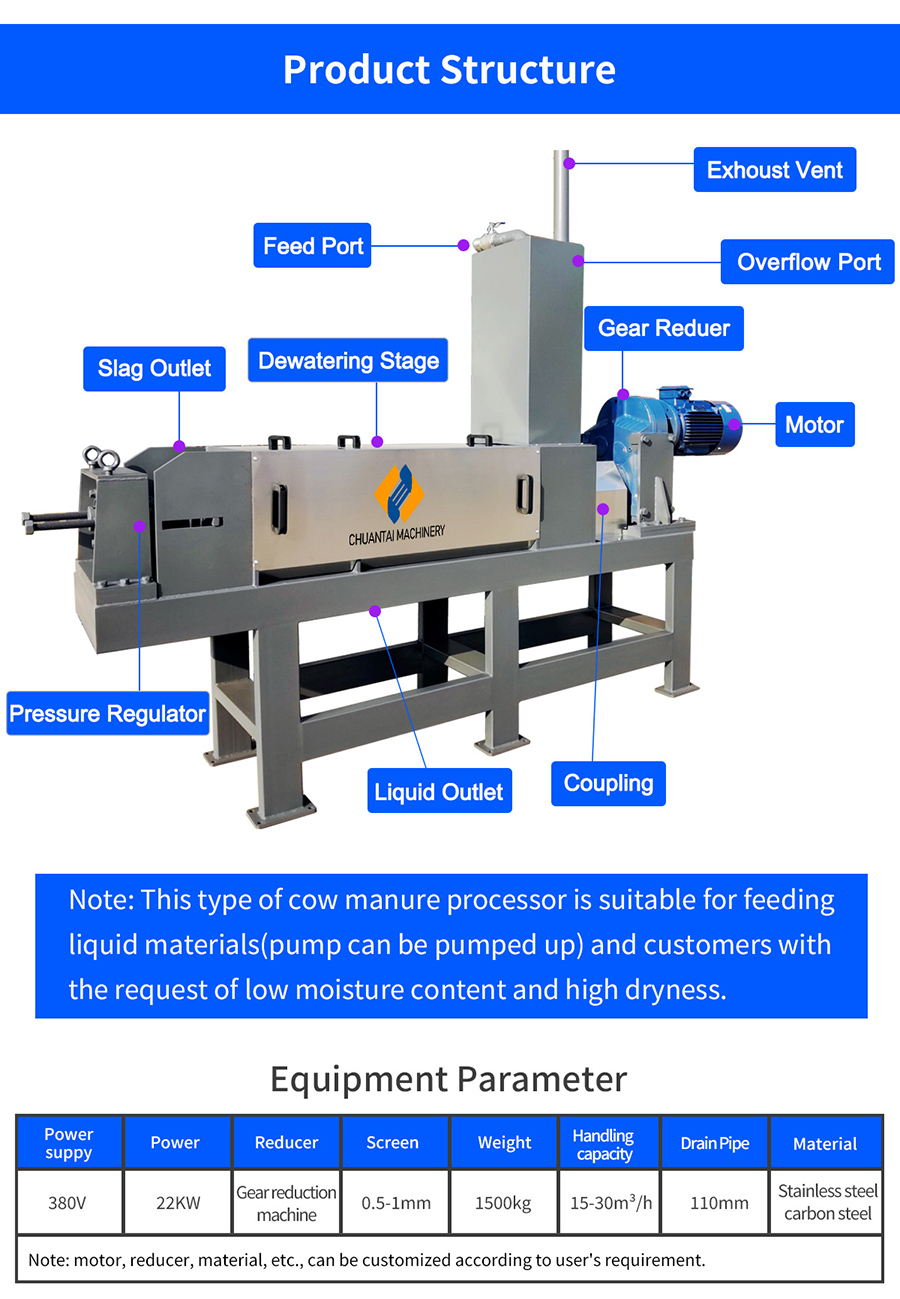
This guide walks through the process stage by stage, sets realistic expectations for dryness and capacity on cow slurry, and finishes with the maintenance routine that separates a machine that runs for ten years from one that seizes a screen every season. If you are still deciding whether separation makes sense for your farm, start with our cow dung dewatering machine overview, which covers the economics; this article deals with the machine itself.
What a manure screw press actually does
Raw dairy slurry typically leaves the barn at 8–12% dry matter — too thick to pump long distances, too wet to stack. The screw press splits it mechanically:
- Solid fraction: the coarse fibre is squeezed to a cake at roughly 40–50% moisture. It stacks, can be composted, and after composting serves as stall bedding.
- Liquid fraction: the effluent drops to around 2–4% dry matter, flows to the lagoon or storage tank, pumps through irrigation lines without clogging, and stirs far less.
The split is purely physical. Fibre is trapped on the screen and compressed; water and dissolved nutrients pass through. That is why the same machine that handles cow dung also handles pig slurry, biogas digestate and other fibrous slurries — and why a slurry with almost no fibre, such as settled fine effluent, dewaters poorly no matter how big the press is.
Inside the machine: four stages in one pass
Feed enters through a hopper, and from there the process is continuous. Four things happen along the length of the screw:
| Stage | Where it happens | What the machine is doing |
|---|---|---|
| 1. Infeed & mixing | Hopper and feed screw | Receives slurry from the pit pump, evens out surges, and starts freeing water immediately |
| 2. Drainage zone | First section of the wedge-wire screen | Thin liquid drains by gravity as the fibre begins to compact against the screen |
| 3. Compression zone | Middle section, where the screw shaft diameter increases | Screw volume shrinks step by step, squeezing the fibre cake and pressing liquid out |
| 4. Discharge & regulation | Outlet cone with spring-loaded regulator | Back pressure sets the final dryness; cake exits as a stackable continuous strip |
The spring-loaded regulator at the discharge end is the single control that matters most in daily operation. Tighten it and the back pressure rises, the cake stays inside longer, and the solids leave drier — but throughput drops. Loosen it and capacity rises while dryness falls. Most farms set it once for composting duty and adjust seasonally, for example running drier cake when bedding demand peaks.
Why the screen does the filtering, not the screw
The screw moves and compresses; the wedge-wire screen separates. Wedge wire is V-shaped in cross-section, so the slots narrow towards the outside. Fibre slides over the surface instead of jamming in the slot, which is what lets the screen run for years on abrasive material. For cow dung, slot openings between 0.5 and 1.0 mm are the usual working range: finer slots capture more fibre but blind faster on sticky slurry, while coarser slots trade solids recovery for throughput. Screen selection is a farm-specific decision — our dairy manure separator guide covers it in detail.
What outputs to expect
Published capacity figures always assume a specific feed. On dairy slurry at 10–12% dry matter, a realistic picture looks like this:
- Cake moisture: 40–50% with the regulator set for composting or bedding duty. Drier is possible on fibrous feed, at the cost of throughput.
- Volume reduction: raw slurry at roughly 10% dry matter separates into about 15–20% of its volume as cake and 80–85% as liquid, by volume.
- Liquid fraction: low enough in fibre to pump to a lagoon or drip-irrigate after screening, and far less prone to crust over in storage.
- Capacity: across the CTYZ range, machines span 0.5–1 m³/h on the smallest frame up to 20–30 m³/h on the largest, so almost any herd size has a matching model.
Capacity depends on how much fibre the slurry carries and how fine the screen is, so treat catalogue figures as a starting point. A trial on your own slurry, at your own screen size, is the only number worth budgeting on.
Six common problems and what causes them
- Wet cake at low throughput — the feed is too dilute, or the reception pit is letting settled fine effluent into the machine. Stir the pit or add a coarse pre-screen.
- Screen blinding every shift — slot too fine for the material, or sticky feed such as undigested silage fibre. Try a coarser screen or increase the flush-water ratio.
- Screw jamming on start-up — hard lumps or stones in the feed. A protection grid on the hopper and a pit stirrer prevent most incidents.
- Cake falls apart instead of extruding cleanly — not enough fibre to form a cake. Very liquid slurry needs recirculation of a portion of the solids or a settling step first.
- Vibration and uneven wear — the screw is out of balance or the screen is worn on one side. Check alignment at the quarterly service.
- Liquid still too fibrous — screen slot too coarse for your downstream pumps. Step down one slot size or add a second-pass settling tank.
None of these are manufacturing defects. All of them are setup or feed issues, and all of them are fixable in the field — usually the same afternoon.
The maintenance routine that keeps it running
| Interval | Task | Why it matters |
|---|---|---|
| Daily | Rinse the screen with clean water after the last batch | Dried slurry in the slots is the main cause of Monday-morning blinding |
| Daily | Grease the main bearings per the manual | Bearings run in a hostile atmosphere; grease is cheap insurance |
| Weekly | Check the discharge regulator spring and cone for wear | Back pressure sets dryness; a worn cone quietly changes the cake |
| Monthly | Inspect screen wear and slot opening | Worn slots pass fibre and lower cake quality long before failure |
| Quarterly | Check screw tip clearance and gearbox oil | The screw tip is the highest-wear point; clearance affects both capacity and dryness |
| Annually | Full inspection: bearings, seals, drive, hard-facing where fitted | Catch wear during low season instead of mid-calving |
Two habits account for most of the difference between farms that get ten seasons and farms that get three. The first is rinsing the screen after every use — dried slurry is concrete for wedge wire. The second is keeping one spare screen and one set of wear parts on the shelf, because a screen that fails during the peak spreading season can idle a farm for weeks while a replacement ships.
Choosing the right frame size
Frame size is a throughput decision, and throughput is a herd-size decision. As a working example: a 500-cow housed dairy producing around 35 m³ of slurry per day can run a mid-range machine for a few hours a day, while a small farm with 50–80 cows is fully served by the smallest frame running one to two hours daily. Our sizing guide for dairy farms walks through the arithmetic, and the CTYZ model pages list the exact figures for each frame.
A cow dung dewatering machine is not a complicated purchase once you know your daily slurry volume and what you want the solids to become. The machine itself has one wearing surface, one control and one filter — understand those three and you understand the whole press.
How dry is the cake from a manure screw press?
On typical dairy slurry the solids discharge at 40–50% moisture with the pressure regulator set for composting or bedding. Tightening the regulator produces drier cake at lower throughput; loosening it does the opposite. Feed with more fibre dries more easily than dilute slurry.
Does a manure screw press need chemicals or polymers?
No. Separation is mechanical: fibre is screened out and compressed by the screw. That is one of its advantages over flocculation-based dewatering, which adds ongoing chemical cost and changes the character of the liquid fraction.
What screen size is right for cow dung?
Slot openings between 0.5 and 1.0 mm cover most cow dung applications. Finer slots recover more fibre but blind faster; coarser slots maximise throughput. Farms that use solids for bedding usually choose a finer screen to capture the long fibre that makes bedding absorbent.
How often should the screen be cleaned?
Rinse with clean water after every use. It takes minutes and prevents the dried slurry build-up that otherwise blinds the screen and kills capacity. Monthly, inspect slot wear while the screen is accessible.
Can one machine handle both cow slurry and pig slurry?
Yes, provided both are fibrous slurries. Adjust the regulator and, if you change feed regularly, allow a rinse cycle between feeds. Capacity will differ: pig slurry typically carries less coarse fibre than cow slurry and yields a wetter cake at the same screen.
Want to see what a manure screw press would do with your slurry? Send us the herd size and slurry volume and we will size the model.
Contact our engineers on WhatsApp for model selection and a free quote.
Related: Cow dung dewatering machine · Sizing a separator for your dairy farm · Screw press operation & maintenance manual · Screw press separator models