Olive Pomace Dewatering with a Screw Press: A Practical Mill Guide
An olive mill makes oil for a few months and pomace every hour of those months. Wet pomace is heavy, oily and gritty, and every litre of water in it is weight you pay to truck, dry or compost. A screw press takes that free water out continuously, before the pomace leaves the yard.
Why Olive Pomace Is Hard to Dewater
Pomace is skin, pulp, broken pit and residual oil, at whatever consistency the decanter produces. The oil makes the mass cohesive, so it smears instead of releasing water. Soft pulp forces into screen openings and blinds the drainage surface. Pit fragments are abrasive and sit where the screw flight rubs hardest.
Seasonality compounds this. In the campaign a mill may run two shifts and make pomace faster than anyone can move it; the rest of the year the machine sits idle. A press that starts, runs slowly and can be flushed and parked suits that pattern. A two-phase decanter also sends out wetter, heavier pomace than a three-phase line.
What Dewatering Changes
- Weight falls before transport, so each truck carries more solids and less water.
- Pressed cake stops dripping, cutting leachate, flies and odour at the storage bay.
- Drying load downstream falls in proportion to water removed mechanically.
How a Screw Press Dewaters Pomace
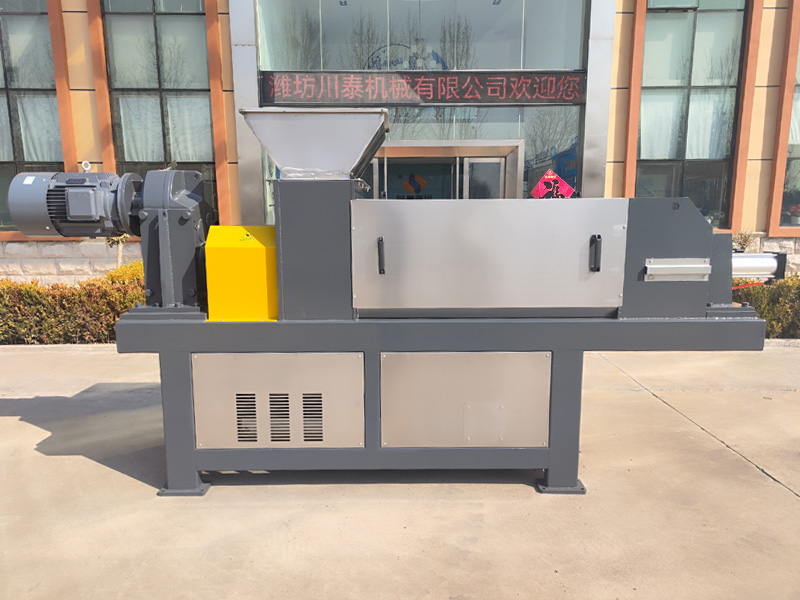
Pomace enters a hopper and is picked up by a screw whose flight pitch narrows along its length. As pitch tightens, the volume between flights shrinks and material is compressed against a wedge-wire screen basket. Water drains through the slots; solids move forward as a plug. An adjustable back-pressure cone at the discharge sets cake dryness — tighter for a drier cake, wider for throughput.
The screw turns slowly, so power demand stays modest: the CTYZ-300 uses 15 kW for 5–10 m³/h. Screw shaft, basket and guard are 304 stainless steel, with 316L for aggressive chemicals.
Settings that matter on pomace
Apertures run from 0.25 mm to 2.0 mm, with 0.75 mm the usual start for fibrous material. Wider openings drain faster but carry more fines into the liquor; narrower ones give cleaner filtrate but blind sooner. On oily pomace, many mills accept a wider aperture and a dirtier liquid.
Decanter Centrifuge vs Screw Press
In a mill these are rarely alternatives. The decanter separates oil from water from solids at high speed; the screw press handles residual pomace at low speed, with the narrower job of removing free water.
| Criterion | Decanter centrifuge | Screw press |
|---|---|---|
| Role in the mill | Separates oil, water and solids | Dewaters pomace after separation |
| Speed | High-speed bowl | Low-speed screw |
| Connected power | High for the separation duty | 15 kW on the CTYZ-300 at 5–10 m³/h |
| Consumables | Bowl wear, bearings, specialist service | Screen basket and screw flight |
| Variable feed | Needs steady dilution and flow | Absorbs swings through back-pressure |
| Output | Oil, water and solids | Press cake plus a fines-laden liquid |
Where Pressed Pomace Can Go
Dewatering does not create a market, but it makes the existing routes workable:
- Compost. Pressed pomace bulks up green waste or manure, and removing free water keeps the windrow from going anaerobic.
- Biomass fuel. Pomace is already burned in some regions; cake that has shed free water ignites with less auxiliary fuel.
- Pomace oil plants. These dry before extraction, so water removed by the press is water the dryer need not boil off.
- Feed, in limited amounts. High lignin and residual bitterness keep inclusion rates modest; confirm rations with a nutritionist.
The liquid fraction is not a product: fines, some oil and a high organic load. Send it to water treatment or a lined pond.
Sizing the Press to Your Campaign
Size on peak hourly output, not the seasonal total. A mill producing 40 tonnes a day over ten hours needs a press matched to roughly 4 tonnes per hour of wet feed, with headroom for hard days.
| Model | Motor Power | Capacity | Screw Diameter | Weight |
|---|---|---|---|---|
| CTYZ-160 | 3 kW | 0.5–1 m³/h | 160 mm | 380 kg |
| CTYZ-200 | 5.5 kW | 2–5 m³/h | 200 mm | 650 kg |
| CTYZ-300 | 15 kW | 5–10 m³/h | 300 mm | 2,300 kg |
| CTYZ-400 | 30 kW | 10–15 m³/h | 400 mm | 3,500 kg |
| CTYZ-500 | 45 kW | 15–20 m³/h | 500 mm | 4,800 kg |
| CTYZ-600 | 55 kW | 20–30 m³/h | 600 mm | 7,500 kg |
A small estate mill often lands on the CTYZ-200 or 300; a cooperative on the CTYZ-400; a plant with several decanter lines on the 500 or 600.
Running a Short Season
Pomace is abrasive and sticky, and the campaign leaves no quiet week for maintenance.
- Inspect basket and flight before the campaign; replace worn parts while you have time.
- Feed steadily — surges overload the compression zone and spike motor current.
- Flush the basket at shift end; dried pomace sets hard and blinds slots overnight.
- Keep a spare basket on site; a swap takes minutes, a part in harvest takes days.
- Record cone position with cake moisture, so settings can be repeated.
At season end, wash down, drain the trough, grease the bearings and leave the cone open. The 12-month warranty covers manufacturing defects, not wear parts such as flight, screen, bearings and seals.
Questions Mills Ask
What cake moisture can a screw press reach on olive pomace?
Our machines are rated for 40–65% output moisture. On pomace the result depends on feed moisture, residual oil, pit content and cone setting, so treat any figure as indicative.
Will oily two-phase pomace blind the screen?
It can if the aperture is too tight or the feed is pushed. A wider aperture, steady feeding and a shift-end flush keep drainage open. For unusually oily pomace, send a sample.
Does the press replace our decanter?
No. The decanter separates oil, water and solids; the screw press dewaters the pomace leaving it. They do different jobs in the same line.
Can it recover residual oil in the pomace?
It is not an oil-recovery machine. Pressing expresses water with some oil and fines, which go to water treatment. Pomace oil recovery belongs to an extraction plant.
Which model suits a mill doing a few tonnes per hour?
The CTYZ-300 handles 5–10 m³/h and is the usual fit for a mid-size mill; smaller estates often choose the CTYZ-200 at 2–5 m³/h. Match peak hourly output.
What aperture should I start with?
0.75 mm is our default for fibrous material and a sensible start on pomace. Go to 1.0 mm if drainage is slow and you can accept more fines; go to 0.5 mm only if cleaner liquid matters more than throughput.
Can we run it only during the campaign?
Yes. Wash and drain at season end, grease the bearings, leave the discharge open and cover the machine. Running it briefly once a month keeps seals from drying out.
Tell us your hourly pomace output and we will size the press for your campaign.
Contact our engineers on WhatsApp for model selection and a free quote.
Related: Fruit pomace dewatering guide · Apple dewatering application · CTYZ-300 screw press · Volute press vs screw squeezer · How to choose a screw press · Screw press buyers guide