What Is a Screw Press? Working Principle, Components and Applications
A screw press is a continuous mechanical dewatering machine that squeezes water out of wet material by compressing it inside a screen barrel with a slowly rotating screw. It is the machine behind most manure separation, food waste dewatering, pulp thickening and forage pressing lines — valued because it runs continuously, uses little power and needs almost no attention while it runs. This guide explains the working principle, the parts that matter and the design parameters that decide performance.
The Working Principle in One Paragraph
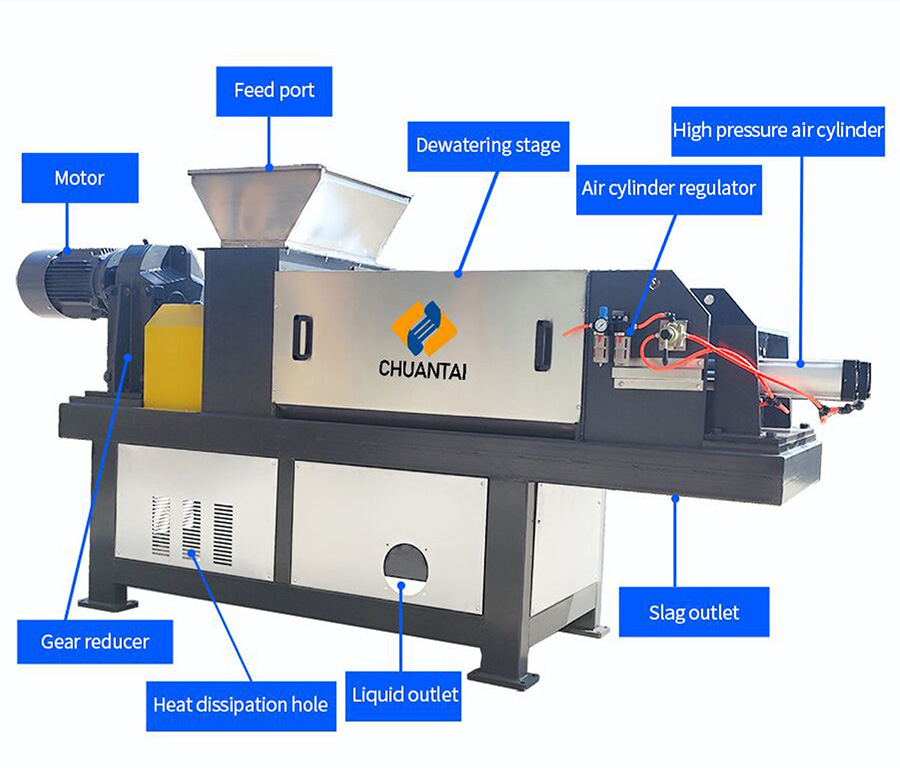
Wet material enters a hopper and meets a rotating screw inside a perforated screen barrel. As the screw conveys the material forward, the space between the screw flights and the outlet shrinks — through a tapered shaft, a reducing pitch, or an adjustable outlet cone. The compression squeezes water out through the screen while the solids travel the length of the barrel and exit as a firm plug. Water drains into a collection pan; the press rate is governed by how hard the cone pushes back.
The Components That Matter
Seven parts decide everything: the feed hopper, the screw (spiral) itself with its shaft, the screen barrel and its aperture, the back-pressure cone or gate, the drive (motor plus gearbox), the frame, and the filtrate pan. The screw and screen do the work; the cone sets the cake dryness; the gearbox sets the torque. When comparing machines, ask about the screen material and how the screw is protected — stainless contact parts and hard-faced flights separate a ten-year machine from a two-year one.
Screw Press Design: the Parameters That Decide Performance
- Screw diameter — sets the throughput class (our CTYZ range runs 160-600 mm).
- Screen aperture — finer apertures capture smaller particles but drain slower.
- Compression ratio — how much the volume shrinks from feed to discharge.
- Rotational speed — slower means gentler fibre handling and more dewatering time.
- Back-pressure adjustment — your day-to-day dryness control.
What a Screw Press Can and Cannot Dewater
If the material contains solid particles a screen can retain, a screw press can dewat it: manure and slurry, food waste, vegetable and fruit residues, spent grain, paper pulp, tea and coffee residue, forage and hemp fibre, digestate. What it cannot do: separate dissolved substances (sugar in water, salts), or handle purely liquid streams — those need evaporation or membrane processes. Emulsified and greasy materials also press poorly and may need coagulation first.
Screw Press vs Other Dewatering Equipment
Against a filter press: continuous vs batch, low vs high labour, medium vs high cake dryness. Against a centrifuge (decanter): far lower purchase and running cost, simpler upkeep, slightly wetter cake. Against a belt press: no fabric to wash or replace, better on fibrous feed. Against drying: an order of magnitude cheaper per tonne of water removed — which is why a screw press is almost always placed before any dryer. For a deeper comparison on a specific material, our applications pages cover more than seventy materials, and the buying guide walks through model selection.
Frequently Asked Questions
Q: What is the difference between a screw press and a filter press?
A: A screw press runs continuously with no plates to open, no cloth to wash and no batch cycle, at the cost of a wetter cake (typically 30-45% dry matter depending on material). A membrane filter press reaches drier cake but works in batches with cloth maintenance and higher labour. Continuous waste streams overwhelmingly favour the screw press.
Q: What materials can a screw press dewater?
A: Any wet material with solid particles that a screen can hold back: animal manure, food waste, vegetable and fruit residue, brewery spent grain, paper pulp, tea leaves, hemp and forage fibre, kitchen waste and digestate. Materials that are purely dissolved (no particles) cannot be pressed.
Q: How dry is the cake from a screw press?
A: Between 25% and 45% dry matter depending on material and back-pressure: manure solids typically 30-35%, brewery grain 25-35%, chopped forage 55-65% moisture equivalent. Adjusting the cone pressure trades dryness against throughput.
Q: What power does a screw press need?
A: Surprisingly little, because separation is mechanical squeezing rather than pumping or evaporation. Common farm and food-industry models run on 3-15 kW motors; the energy to remove a tonne of water is a fraction of what thermal drying requires.
Want to know what a screw press would do with your material?
Send a sample for a free pressing test, or browse the full CTYZ screw press range from 160 to 600 mm screw diameter.