Shredder Operating Cost Per Ton: What a Double Shaft Shredder Really Costs to Run
Asking about the operating cost per ton of a double shaft shredder is the right question to ask before buying one. The purchase price is a one-off; the running cost repeats every shift for the next ten years. This guide breaks the per-ton figure into its four parts — electricity, cutting tools, labour and maintenance — shows a worked example, and lists the five levers that reduce it.
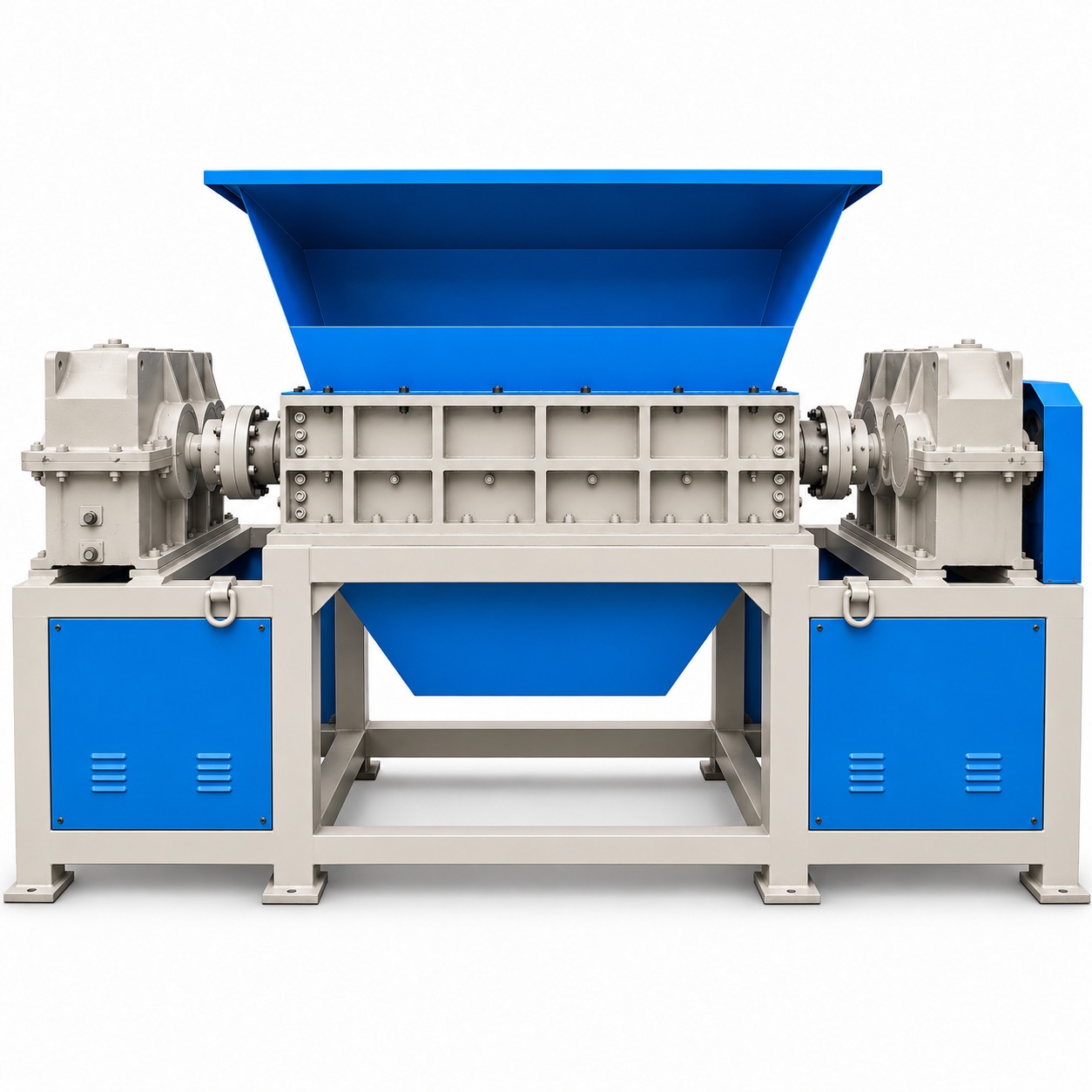
The Four Parts of Shredder Operating Cost
Every per-ton figure is built from four components. Electricity is usually the largest, followed by cutting tools. Labour and scheduled maintenance are smaller but not negligible. When suppliers quote "low operating cost" without splitting these four, treat the claim as marketing.
Electricity: the Biggest Line Item
A double shaft shredder is a low-speed, high-torque machine. Our CTSS series runs at roughly 15–30 rpm: the gearbox trades speed for torque, so the motor works near its efficient range instead of stalling against tough feed. In practice a mid-size twin-shaft machine processing mixed waste draws around 1.5–3 kWh per ton. Hard, clean materials like rigid plastic or wood pallets sit at the bottom of that range; whole tires with steel beads sit at the top.
To estimate your own figure: motor power (kW) × average load factor (typically 60–80%) ÷ actual throughput (t/h) × your electricity price. A machine fitted with two 45 kW motors running 6 tons per hour at 70% load draws about 10.5 kWh per ton — multiply by your tariff and you have the energy share of your cost per ton.
Blades and Wear Parts
Blades are consumables, and honest suppliers say so. Blade life depends almost entirely on what you feed: clean wood and plastics can run 1,000+ hours before a regrind, while abrasive or metal-contaminated waste cuts that to a few hundred hours. The practical way to control this cost is rotation: keep two or three blade sets, swap and regrind on a fixed schedule, and spread the regrind cost over the tonnes processed. On a well-run line, tooling typically adds USD 0.3–1.0 per ton.
Other wear items — screen elements if fitted, wear plates, conveyor belts — are minor but should appear in your budget as a fixed annual allowance rather than a surprise.
Labour and Supervision
A double shaft shredder tolerates uneven feed better than a single-rotor machine, so one operator can typically supervise shredding together with loading and conveying. Budget one operator-hour per shift for the shredding stage; on automated lines with a feed conveyor and oversize return, the machine becomes a stop on an operator’s round rather than a full-time post.
Maintenance and Downtime
Scheduled maintenance on a twin-shaft machine is light: gearbox oil checks, bearing greasing, hydraulic inspection if fitted, and the blade rotation cycle. Plan 2–4 hours per week of attention plus one blade service per quarter. Downtime hits your cost per ton through lost hours, so the cheapest maintenance is the kind that happens on schedule instead of after a breakdown.
Worked Example: Mixed Waste on a CTSS-1200
Take a CTSS-1200 with two 45 kW motors, processing 6 t/h of commercial waste at an electricity price of USD 0.10/kWh. Energy works out to roughly USD 0.20–0.30 per ton. Add tooling at USD 0.50, a quarter of an operator-hour at USD 0.75, and a maintenance allowance of USD 0.30. Total: approximately USD 1.8–1.9 per ton — before any revenue from the shredded output, which for tires, plastic or wood chips often exceeds the entire running cost.
Five Ways to Lower Your Cost Per Ton
- Size the machine to the real, measured throughput — not the optimistic one.
- Pre-remove large tramp metal; a scrap crane magnet pays for itself in blades.
- Rotate blade sets on schedule instead of running them to failure.
- Shred during off-peak electricity tariffs where your meter allows it.
- Keep the feed steady: an empty shredder still draws power but produces nothing.
Related reading: how the purchase price itself varies is covered in our double shaft shredder price factors guide, and the machine-level comparison is in twin shaft vs single shaft shredder.
Frequently Asked Questions
Q: What is a realistic operating cost per ton for a double shaft shredder?
A: For mixed municipal or commercial waste on a mid-size machine, electricity typically accounts for 1.5-3 kWh per ton. Adding blades, labour and maintenance, most operators land between USD 1.5 and USD 4 per ton depending on local power prices and material toughness. Tires sit at the higher end, plastic and wood at the lower end.
Q: Does a bigger shredder cost less per ton?
A: Usually yes. A larger machine runs at a higher ton-per-hour rate with proportionally less labour, and its low-speed high-torque drive converts electricity into shearing work efficiently. The trap is buying too large: a half-empty large machine can burn more kilowatt-hours per ton than a correctly sized smaller one.
Q: How long do blades last before replacement?
A: Between 400 and 1,500 operating hours depending on material: clean plastic and wood are gentle on blades, tires with steel beads and abrasive MSW shorten life considerably. Stacking two or three blade sets and rotating them between regrinds keeps the per-ton tooling cost predictable.
Q: Can I get an exact per-ton figure for my material?
A: Yes. Send a material sample for a free test shred. The test records actual throughput and power draw, which converts directly into a kWh-per-ton and cost-per-ton figure for your project instead of a catalogue estimate.
Want a cost estimate for your own material?
Browse the CTSS double shaft shredder range, see all machines on Products, or contact us with your daily tonnage for a per-ton operating calculation and a free quote.